

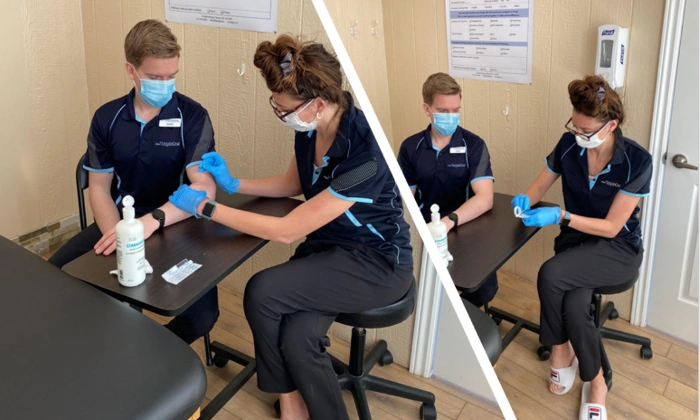
Functional dry needling is a skilled technique in which a therapist uses a filiform — or dry — needle to reach muscle and other tissue, to influence how the body works and to treat neuromuscular conditions, pain and dysfunction.
The technique was first proposed for stimulating muscles in the early 1930s, and came into wide use in the 1980s as more research was published.
How does it help?
- It can decrease pain, increase range of movement and increase strength.
- It acts as a reset for a dysfunctional muscle and its nervous system circuit.
- A muscle that is too tight or knotted is reset to a looser, more relaxed state.
- A muscle that is underactive can be stimulated into working again.
Why is it called dry needling?
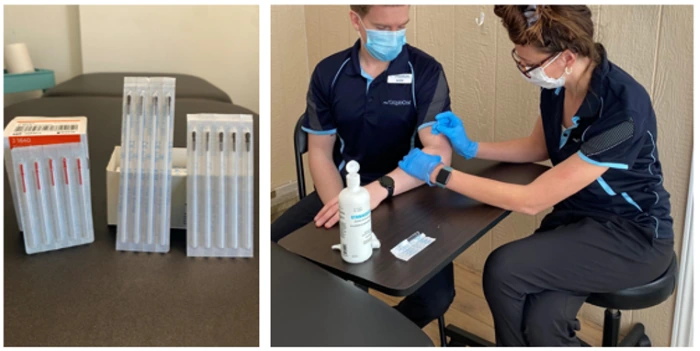
Because the filiform needles inject nothing into the body — hence “dry”. They look more like a pin than a needle, and instead of slicing the muscle open for an injection, the way needles do for vaccines and shots, these slide in smoothly.
How does it work?
Very thin needles are inserted into the muscle to relieve pain, decrease weakness and increase the range of movement available. It sounds alarming. Here is why it is not:
- The needles are very thin — thin enough to fit on the end of a standard flu shot needle.
- Injection needles are designed to cut into a muscle and open it up so the substance has somewhere to go. Dry needles are designed to slide through. The intention is the smallest possible trauma, enough to restart the muscle's healing response without lasting damage that needs repair.
- They are done by the chatty physio you already see every week, not by a stranger in a lab coat.
Is there a difference between dry needling and acupuncture?
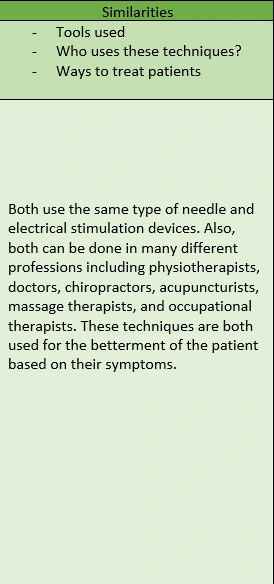
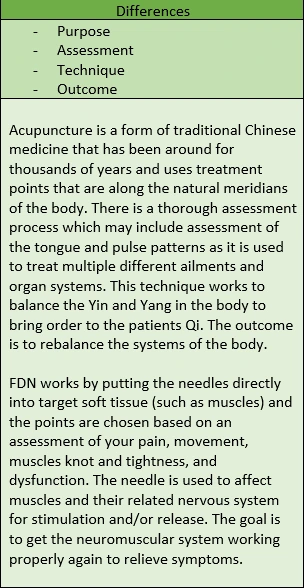
Yes. The two share needles and electrical stimulation devices, and both are practised across several professions, but they come from different places and work differently.
How long does it last?
Typically two to three days. Combined with your daily exercises it lasts longer, and over time helps reverse the dysfunction altogether.
Think of it this way. A dodgy appliance keeps throwing the breaker. You can reset the breaker — dry needling regaining the neuromuscular balance — but if the appliance is still faulty it will throw the breaker again in a couple of days. Fix the appliance, which is to say retrain the muscle, and eventually it stops.
What are the benefits?

What can go wrong, and how do we avoid it?
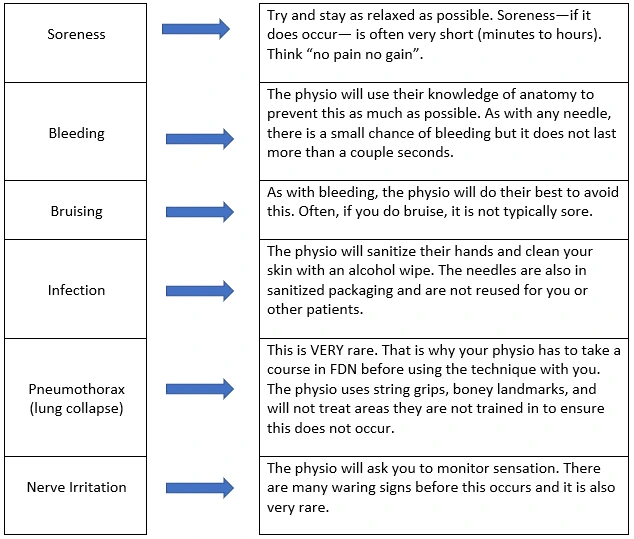
Is dry needling for me?
It might be. It is not safe for everyone — not in the first trimester of pregnancy, and not for people with bleeding or clotting disorders, among other conditions. And if you strongly dislike needles, or have a real phobia of them, it may not be the treatment for you.
Talk to your physiotherapist and work out together whether it suits you.
Wondering whether dry needling would help your rehab? Call LiquidGym at 613-820-8228.
References
- Ahn AC, Colbert AP, Anderson BJ, et al. “Electrical Properties of Acupuncture Points and Meridians: A Systematic Review.” Bioelectromagnetics. 2008;29:245–256.
- Boyles R., Fowler R., Ramsey D. and Burrows E. (2015). “Effectiveness of trigger point dry needling for multiple body regions: a systematic review.” Journal of Manual & Manipulative Therapy, 23(5), 276–293.
- Evidence in Motion, Functional Dry Needling Level 1 course, 2021.
- FSBPT. “Analysis of Competencies for Dry Needling by Physical Therapists.”
- Gafarov GA. “Acupuncture Research Methods.” Journal of Applied Biotechnology and Bioengineering. 2020;7(6):276–278.
- Legge, David (2014). “A History of Dry Needling.” Journal of Musculoskeletal Pain, 22.
- Vickers AJ, Cronin AM, Maschina AC, et al. “Acupuncture for Chronic Pain: Individual Patient Data Meta-Analysis.” Archives of Internal Medicine. 2012;172(19):1444–1453.